Before you book anything
Singapore rewards a little planning more than most cities. It's compact, safe and superbly connected — but it's also hot, humid and easy to over-schedule. The single biggest mistake first-timers make is treating it like a temperate city and cramming three outdoor attractions into one afternoon. Plan around the heat and everything else falls into place.
Entry is simple for most Western passport holders: no visa needed for tourism, but every traveller must complete the free SG Arrival Card on the ICA website within three days before arrival. Do it on your phone; it takes five minutes. For official attraction details, events and opening hours while you plan, the Singapore Tourism Board's Visit Singapore site is the authoritative companion to this guide.
How long to stay
Four to five days is ideal. Here's the honest breakdown:
- Day 1: Marina Bay area — Gardens by the Bay, the waterfront, Merlion photo if you must.
- Day 2: A heritage neighbourhood day — Chinatown or Kampong Gelam, done slowly, with hawker meals.
- Day 3: Nature — Botanic Gardens in the morning, then either the Southern Ridges walk or the Mandai wildlife parks.
- Day 4: Little India, Tiong Bahru or Katong — the neighbourhoods most visitors miss and most enjoy.
- Day 5: Sentosa if you're travelling with kids, or a slow café-and-museum day if you're not.
When to visit
Singapore is 26–33°C every single day of the year, so there's no bad season — only wetter and drier ones. November to January is the wetter monsoon period; February to April tends to be slightly drier. Rain arrives in short, dramatic bursts rather than all-day drizzle, so it rarely ruins a trip. Check the official Meteorological Service Singapore forecast rather than generic weather apps, which handle tropical rain badly.
Where to stay
Location matters less here than in most cities because the MRT is excellent — but it still shapes your trip. Marina Bay is spectacular and sterile; Chinatown and Kampong Gelam give you character and food at your doorstep; Orchard is convenient and forgettable. I've written a full neighbourhood-by-neighbourhood guide to where to stay — read that before booking.
Money, costs and tipping
Singapore is cashless-friendly: contactless cards work almost everywhere, including on the MRT and buses. Keep SGD 20–30 in cash for older hawker stalls. GST is 9% and usually included in displayed prices; restaurants add a 10% service charge, and tipping beyond that is not expected anywhere. A realistic daily budget excluding accommodation: SGD 50–70 eating at hawker centres and using public transport, SGD 150+ if you're doing restaurants and attractions daily.
Getting around
The MRT will handle 90% of your trip, and your contactless Visa or Mastercard works directly at the gates — no tourist pass needed for most visitors. Grab (Southeast Asia's Uber) fills the gaps. I've covered fares, apps and the walking-in-heat problem in the full getting around Singapore guide.
Food: the actual reason to come
Hawker centres are Singapore's greatest institution — UNESCO-listed food culture at SGD 5 a plate. Don't waste meals on hotel breakfasts and mall food courts. Start with the hawker food guide, which covers what to order, how queues work, and the dishes worth planning a day around.
Etiquette and rules worth knowing
- No eating or drinking on the MRT — including water. Fines are real, but mostly you'll just get glares.
- Chewing gum isn't sold here; bringing a pack for personal use is fine.
- Jaywalking laws exist but the practical rule is simpler: traffic is orderly, crossings are everywhere, use them.
- Tap water is safe to drink everywhere. Refill a bottle and save money.
- Dress is casual — shorts and sandals are fine almost everywhere except high-end restaurants and places of worship, where covered shoulders and knees are expected.
What to skip
Honest local opinion: the Merlion is a two-minute photo, not an activity. The Singapore Flyer is skippable if you're doing the Marina Bay Sands SkyPark or CÉ LA VI. Orchard Road is a shopping street — if you have Westfield or Oxford Street at home, you've seen it. Spend that time in a neighbourhood instead — and if the culture hooks you, the story of Singapore's Chinese dialect groups is the best ten-minute primer on how this city came to be.
A five-day first visit, day by day
Five days is Singapore's perfect number: enough for the icons, the neighbourhoods and the slow local hours that make the trip, without the padding that longer stays invite. This is the plan I actually give first-time visitors — built on the local rhythm (out early, indoors midday, out again at five), with every day carrying a built-in rain pivot. Trust the sequence; it's doing more work than it looks.
Day 1 — arrival + Marina Bay, gently
Whatever your jet-lag state: kopitiam breakfast, then the Marina Bay waterfront loop before the heat — Merlion photos happen here, incidentally. Midday indoors (National Gallery or your hotel pool, honestly). Evening: hawker dinner at Maxwell or Lau Pa Sat, then the free Gardens by the Bay light show (currently 7:45pm). Rain pivot: swap the loop for the ArtScience Museum.
Day 2 — Chinatown + Gardens by the Bay properly
Chinatown early: the wet market and Chinatown Complex before 10am, temple row on South Bridge Road, kopi when the heat arrives. Midday: the Cloud Forest and Flower Dome, booked the night before — indoors, spectacular, ideally 1–4pm. Evening: Keong Saik or Duxton for dinner, or back to Chinatown Complex to eat where lunch queues told you to. Rain pivot: the domes ARE the pivot; flip morning and midday.
Day 3 — Kampong Glam + Little India: the layered morning
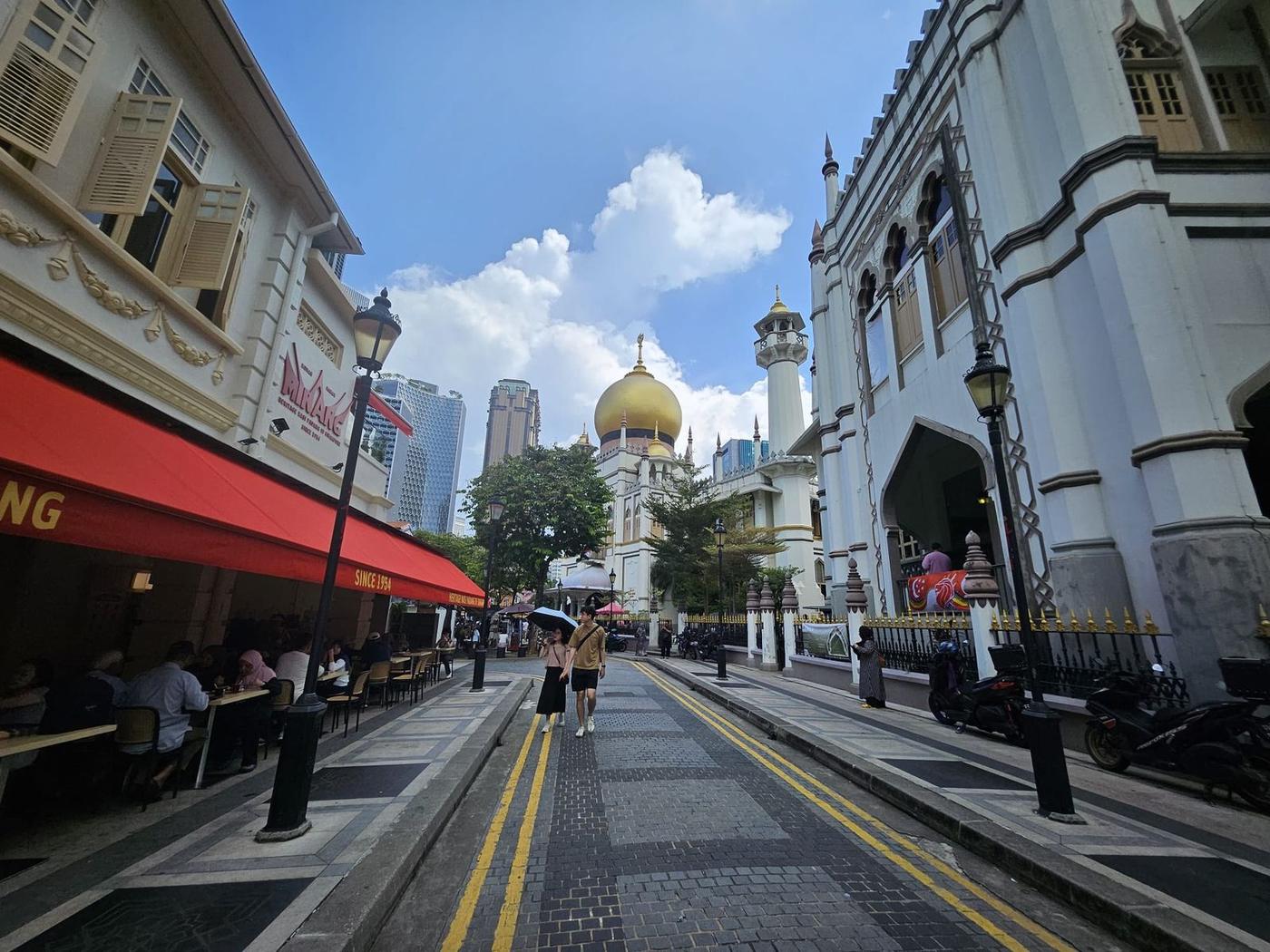
Sultan Mosque and Bussorah Street from 9:30, Haji Lane's murals and shops as they open, then walk into Little India — Tekka Centre for lunch (biryani, teh tarik) among the market noise. Midday retreat: the Peranakan Museum or the National Museum, both nearby and cool. Evening: return to Little India as it wakes — it's a night neighbourhood at heart. This is the day that converts visitors into Singapore people.
Day 4 — Sentosa OR nature, by honest self-assessment
Family with Universal Studios or Oceanarium bookings: take the full Sentosa day, arrive at opening. Everyone else: half-day maximum (beach morning, one activity), then reclaim the afternoon — or skip Sentosa entirely for the Southern Ridges walk (Henderson Waves at golden hour) or the Botanic Gardens, which cost nothing and photograph better. Evening: East Coast for chilli crab by the sea, the classic done right. Rain pivot: the Oceanarium turns wet Sentosa from write-off into highlight.
Day 5 — your Singapore
The day the itinerary earns its keep: repeat whatever grabbed you — the hawker centre you want one more crack at, Tiong Bahru's market morning, the museum you rushed, or genuinely nothing but a pool and a long kopitiam breakfast. Departure logistics: Jewel's Rain Vortex absorbs a pre-flight hour perfectly, and the MRT runs straight to Changi. Fly out having eaten like a local (the complete induction makes that certain), read the street (see the mistakes guide), and left with a reason to come back — which our second-visit guide will be waiting for.
Local’s note: Three structural rules that make this itinerary work: never two icon-days back-to-back (crash guaranteed); book exactly two things in advance (the domes and any Sentosa headliner) and leave the rest to appetite; and eat every lunch at a hawker centre — it's the cheapest, truest 45 minutes each day, and the queues are more current than any guide, including this one.
Want this shaped to your dates, party and appetite? The Local Brief →
If you only have three days
Three days in Singapore is enough to understand why people decide to stay. Not enough to see everything — the standard tourist circuit gives you Marina Bay Sands, the Botanic Gardens, Chinatown, and a hawker centre — but enough to get past the surface of a city that repays attention. This itinerary is structured by a local, for visitors who want to eat well, understand something of what they're seeing, and leave with more questions than they arrived with. That is, I think, the right way to leave any city worth visiting.
Day 1: Neighbourhoods and hawker culture
Morning — Tiong Bahru (7:30 AM–11:00 AM): Start at Tiong Bahru Market before 9 AM. The wet market is active from 6 AM; by 10 AM it begins to wind down. Have breakfast at the hawker centre below — chwee kueh (steamed rice cakes with preserved radish) from the Jian Bo Shui Kueh stall, which has been there since 1958. Order kopi-o (black coffee, sweetened) from any of the drink stalls and understand immediately why people miss Singapore kopitiams when they leave. Then walk the Art Deco residential streets: Eng Hoon Street, Yong Siak Street, Kim Pong Road. The architecture is from the 1930s and 40s and is unlike anything else in Asia at this concentration. Browse BooksActually. Buy something.
Afternoon — Chinatown (12:00–4:00 PM): Take the MRT two stops to Outram Park and walk into Chinatown. Sri Mariamman Temple on South Bridge Road first — Singapore's oldest Hindu temple, built in 1827, in the middle of the Chinese quarter, which tells you something important about how Singapore's ethnic geography actually works. Then Thian Hock Keng Temple on Telok Ayer Street, built by Hokkien immigrants between 1839 and 1842 as a thanksgiving for safe sea crossing. Lunch at Chinatown Complex Food Centre — find a claypot rice stall, accept the 30-minute wait, and consider it part of the experience.
Evening — Night market and hawker supper: Maxwell Food Centre for dinner (Tian Tian chicken rice if you can accept the queue, or explore independently across the 100+ stalls). Then walk towards Clarke Quay along the Singapore River — the restored shophouses at Boat Quay, the river itself, and the view back towards the Cavenagh Bridge are worth the short walk. Clarke Quay for a drink if you want it; the river walk for the air if you don't. End the evening at a kopitiam rather than a bar — the economics and the atmosphere are both better.
Day 2: Heritage quarters and gardens
Morning — Kampong Glam (8:30 AM–12:00 PM): Take the MRT to Bugis (EW12/DT14). Walk north toward Sultan Mosque — the golden domes are visible from several streets away. Visit the mosque (dress modestly; robes available to borrow). Walk along Arab Street for the textile shops. Turn into Haji Lane for the murals and the boutiques. Have breakfast at Zam Zam Restaurant on North Bridge Road — the murtabak has been made here since 1908 and is the right thing to eat in this neighbourhood.
Afternoon — Singapore Botanic Gardens (1:00 PM–5:00 PM): Take a Grab or taxi to the Botanic Gardens (20 minutes from Bugis). The National Orchid Garden within the grounds is the centrepiece — over 1,000 species, hybrid orchids named after visiting heads of state, and a combination of scientific collection and aesthetic arrangement that justifies the small admission fee. The rest of the gardens are free and occupy 74 hectares of jungle, formal planting, and open lawn that has been in continuous use since 1859. The Bandstand area, the Swan Lake, and the Heritage Trees are worth finding. Allow two to three hours.
Evening — Little India (6:00 PM–9:00 PM): Take the MRT to Little India (NE7/DT12). The best time to visit Little India is the early evening, when the working day ends and the streets fill with workers from the construction and services industries who live in the surrounding areas. The atmosphere is distinctly different from the rest of Singapore — louder, more crowded, more visually busy, and completely absorbing if you let it be. Eat at Komala Vilas on Serangoon Road, a South Indian vegetarian restaurant that has been operating since 1947 and serves thali meals that are excellent and very cheap. Walk Serangoon Road and the surrounding streets until you've had enough.
Day 3: Marina Bay and the other Singapore
Morning — Gardens by the Bay (8:00 AM–12:00 PM): The Supertrees are free to view from the outdoor park, which opens early. The Flower Dome and Cloud Forest (paid admission) are best visited when they open — beat the afternoon heat and the main tourist crowds. The Flower Dome replicates a Mediterranean climate; the Cloud Forest has a 35-metre indoor mountain with a waterfall. Both are genuinely impressive rather than merely Instagrammable, which is rarer than it should be for major Singapore attractions.
Afternoon — Marina Bay Sands and city (1:00 PM–5:00 PM): The Marina Bay Sands rooftop (57th floor, hotel guests only for the pool; SkyPark observation deck open to visitors for a fee) gives the perspective that makes the city comprehensible — the density, the harbour, the clear boundary between reclaimed land and sea. The walk around Marina Bay itself — past the ArtScience Museum, the Helix Bridge, and along the waterfront to Esplanade — is one of Singapore's better urban walks. Free and takes about 90 minutes.
Final evening — Hawker centre send-off: Lau Pa Sat (on Raffles Quay, a converted Victorian cast-iron market) for the satay street that sets up outside in the evenings — grilled satay with peanut sauce and ketupat, in a setting that is simultaneously historic and functional. Or Newton Food Centre (on Scotts Road, made famous by Crazy Rich Asians) if you want the full tourist-meets-local hawker centre experience. Order too much. Leave with full understanding of why food is how Singaporeans express care.
What locals know that guidebooks miss
Singapore is one of the easiest cities in the world to visit and one of the most consistently underestimated. Most visitors arrive expecting a sterile, efficient, expensive version of a Southeast Asian city and leave having eaten the best food of their trip, navigated an effortlessly functional public transport system, and discovered that the line between tourist attraction and genuine local life is significantly thinner here than anywhere else they've been.
This guide is written from the perspective of someone who has lived in Singapore for a lifetime and has watched the city receive millions of visitors. It covers what actually matters for a good trip — not a comprehensive list of everything, but an honest account of what to do, what to skip, and what the guidebooks consistently get wrong.
When to visit Singapore
Singapore sits 1.35 degrees north of the equator. This means two things: the temperature is essentially the same year-round (30–33°C during the day, 24–26°C at night), and the daylight hours are almost constant (about 12 hours of daylight throughout the year). There is no summer and no winter. There is a wet season and a slightly less wet season.
The Northeast Monsoon runs roughly November through January, bringing the heaviest and most consistent rainfall. Showers are intense but short — typically 20–40 minutes — and clear completely. The Southwest Monsoon (June through September) brings drier conditions relative to the Northeast Monsoon period, though rain remains a daily possibility. The inter-monsoon periods (April-May and October) can have unpredictable heavy showers.
The practical implication for visitors: there is no bad time to visit Singapore from a weather perspective, because the rain, when it comes, clears quickly and the temperature barely changes. The considerations that actually affect visit timing: school holidays (June and December are peak periods with higher hotel prices and more crowded attractions), Chinese New Year (late January or February — extraordinary atmosphere in Chinatown, some businesses close for 1-2 days), and the Formula 1 Singapore Grand Prix (usually September — book accommodation months ahead).
Getting to Singapore
Changi Airport is consistently rated among the world's best airports and the rating is deserved — the terminal design, the signage, the speed of immigration processing, and the overall experience of arriving at Changi sets a standard that most major airports fail to match. From the arrival hall to your hotel takes 45–60 minutes by MRT (fast, SGD 1.70–2.00) or 20–30 minutes by taxi or Grab (SGD 22–35 to the city, including the airport surcharge).
Singapore has direct flight connections to virtually every major city in Asia and the Pacific, and direct or one-stop connections from Europe, North America, and Australia. Singapore Airlines is consistently rated among the world's top carriers. From Sydney: approximately 8 hours. From London: approximately 13 hours. From Los Angeles: approximately 17–18 hours, typically with one connection.
Getting around Singapore
The MRT (Mass Rapid Transit) is the primary transport mode for tourists and the most efficient for most journeys. Get an EZ-Link card at Changi and tap in and out at every MRT station and bus stop. Single journeys cost SGD 0.92–2.17 depending on distance. The network covers the island comprehensively and runs from approximately 5:30 AM to midnight.
Grab (the regional equivalent of Uber) is the practical supplement for journeys not well-served by MRT, for late-night travel after the MRT closes, and for travel with luggage. Download the app before you arrive and link your credit card — it works from your home country phone number. Prices are transparent and the service is reliable. Traditional taxis are still available and can be hailed at taxi stands or booked via phone apps.
Walking is underrated in Singapore. The city's covered walkways — networks of sheltered pedestrian paths connecting MRT stations to buildings, malls, and streets — make walking in the rain largely possible. The thermal environment means walking in direct midday sun is uncomfortable, but morning and evening walking is genuinely pleasant.
Where to stay
The standard hotel zones — Orchard Road, Marina Bay, the CBD — offer proximity to major attractions but remove you from the Singapore that is worth knowing. The accommodation choices that work best for travellers who want genuine Singapore exposure: Tanjong Pagar (walking distance to Maxwell Food Centre, Chinatown, and the CBD), Tiong Bahru (Art Deco neighbourhood, excellent hawker market five minutes away), Bugis (central, walking distance to Kampong Glam and Chinatown, good MRT access), and the Katong/East Coast area (neighbourhood character, Peranakan architecture, excellent food).
Budget: boutique hotels in Tanjong Pagar and Bugis run SGD 120–200 per night. Standard business hotels on Orchard Road: SGD 200–350. Marina Bay Sands: SGD 400–600 and upward. The MRT makes location less critical than in most cities — staying 15 minutes from the centre by rail rather than walking distance is a meaningful cost saving with a minimal impact on your actual experience.
What to eat: the honest guide
The correct answer to "where should I eat in Singapore" is "a hawker centre." Not as a one-time cultural experience but as the primary mode of eating for your entire trip. Singapore's hawker centres are UNESCO-listed, genuinely excellent, and cost SGD 3.50–7.00 per dish. A complete meal with a drink costs SGD 5–8. The gap between a hawker centre meal and an equivalent restaurant meal in Singapore is not quality — it is often a step down in quality to eat at a restaurant.
Maxwell Food Centre (Tanjong Pagar) for first-timers: the Tian Tian chicken rice, the chwee kueh, the claypot rice. Chinatown Complex Food Centre for scale and authenticity. Old Airport Road Food Centre in Geylang for the best overall concentration of quality stalls. Newton Food Centre for the satay and the atmosphere. Lau Pa Sat for the heritage building and evening satay street.
Specific dishes worth seeking: Hainanese chicken rice (Singapore's national dish — poached chicken, fragrant rice, three sauces), laksa (spicy coconut-milk noodle soup), char kway teow (stir-fried flat rice noodles with wok hei smokiness), bak kut teh (pork rib soup, peppery Teochew style), roti prata (flaky South Indian flatbread with curry dip), and kaya toast (toasted bread with coconut egg jam, soft-boiled eggs, and kopi).
What to see: the standard circuit and what's beyond it
The standard tourist circuit — Marina Bay Sands, Gardens by the Bay, Chinatown, Orchard Road — is worth doing. Marina Bay Sands' 57th-floor rooftop gives the perspective that makes the city comprehensible. Gardens by the Bay's Flower Dome and Cloud Forest are genuinely impressive. Chinatown's temples are historically significant and actively used. None of these are tourist-board confections — they are real and worth your time.
What's beyond the circuit: Tiong Bahru's Art Deco residential streets and independent shops (walk Eng Hoon Street, Yong Siak Street, visit BooksActually). Kampong Glam's Sultan Mosque, Haji Lane murals, and Arab Street textile shops. Little India's Tekka Market and Serangoon Road at dusk. The Singapore Botanic Gardens (UNESCO World Heritage Site, free admission, the Tembusu tree on the main lawn appears on the Singapore $5 note). Tanjong Pagar's preserved shophouses and the food culture of the streets around Maxwell.
A day trip to Johor Bahru, Malaysia — 30 minutes by bus across the Causeway — gives context for Singapore's relationship with its neighbour and is an efficient way to experience the region beyond the island itself.
Practical knowledge that makes the trip better
Carry a compact umbrella every day — not a poncho, which is too hot to wear, but a small foldable umbrella that fits in a bag. Singapore rain is intense but short. Duck into a hawker centre when it starts, eat something, continue when it clears. This is what Singaporeans do.
The temperature contrast between Singapore outdoors (32°C) and Singapore indoors (18–20°C) is stark. Carry a light layer for restaurants, cinemas, and the MRT. The malls are particularly cold.
The UV index in Singapore is Extreme category year-round. Apply SPF 50+ sunscreen before outdoor activities and reapply every 90 minutes. The equatorial sun doesn't look more intense than elsewhere — it is.
Respect the rules. Singapore is well-known for its fines — SGD 300 for littering, SGD 500 for eating on the MRT, SGD 1,000 for smoking in prohibited areas. These fines are real, consistently enforced, and apply to tourists. Knowing them in advance means you simply don't encounter them. The Singapore Fine City game on this website covers the full list in an educational format.
中文读者:这篇指南有完整的中文版 — 第一次来新加坡:本地人写的实用指南。
Frequently asked questions
Is 5 days enough for Singapore?
Five days is the sweet spot for a first visit: the icons, three distinct heritage neighbourhoods, a Sentosa-or-nature day, and a flexible final day — without padding. Three days covers highlights at a rush; a week suits families or repeat visitors.
What should first-time visitors book in advance in Singapore?
Exactly two things: the Gardens by the Bay conservatories (book the night before, go 1–4pm) and any Sentosa headliner like Universal Studios or the Oceanarium. Leave everything else — especially meals — to the day's appetite and the hawker queues.
Should I include Sentosa in a 5-day Singapore itinerary?
With Universal Studios or Oceanarium bookings, give it a full day at opening. Otherwise a half-day is the honest allocation — the Southern Ridges walk and Botanic Gardens are free and often more memorable.
How do I plan for rain on a Singapore itinerary?
Build every day with an indoor 12–4pm anchor (museums, conservatories, long hawker lunches) and check NEA's live radar rather than forecasts — most storms clear one spot within an hour, so you swap the day's order, not its contents.
How many days do I need in Singapore?
Four to five days is the sweet spot for a first visit. Three days covers the highlights at a rushed pace; five lets you add a neighbourhood day and a slower morning. A week works well if you prefer travelling slowly or are combining Singapore with a beach break nearby.
Is Singapore expensive to visit?
Accommodation and alcohol are expensive; almost everything else is reasonable. Hawker meals cost SGD 4–8, MRT rides under SGD 2.50, and many of the best experiences — the Botanic Gardens, neighbourhood walks, the Southern Ridges — are free.
Do Australians, Brits and Americans need a visa for Singapore?
No visa is required for tourism for Australian, UK and US passport holders — you'll typically be granted up to 90 days on arrival. Everyone must submit the free SG Arrival Card online within three days before arriving.
Is English widely spoken in Singapore?
Yes — English is the working language of Singapore. All signage, menus and public transport announcements are in English, which is one reason it's such an easy first stop in Asia.
Want this planned for you, personally?
Order the Local Brief and get a written Singapore plan built around your dates, pace and budget — by someone who actually lives here. Everything is done by email, so time zones do not matter.
Book the Local Brief →Most of what makes Singapore easy is habit rather than information — choping a seat, reading the radar instead of the forecast, eating before the queue forms. The free SG Insider’s 10 collects the ten that matter most. Free, by email, no signup.